

The past decade has seen one of the most significant technological shifts in the media industry’s history. Content creation has become democratised, global distribution has accelerated, and viewer expectations have evolved from passive consumption to immersive, instant, and personalised experiences. Audiences are no longer tied to broadcast schedules or physical devices - they expect content that follows them: across platforms, across borders, and across contexts.
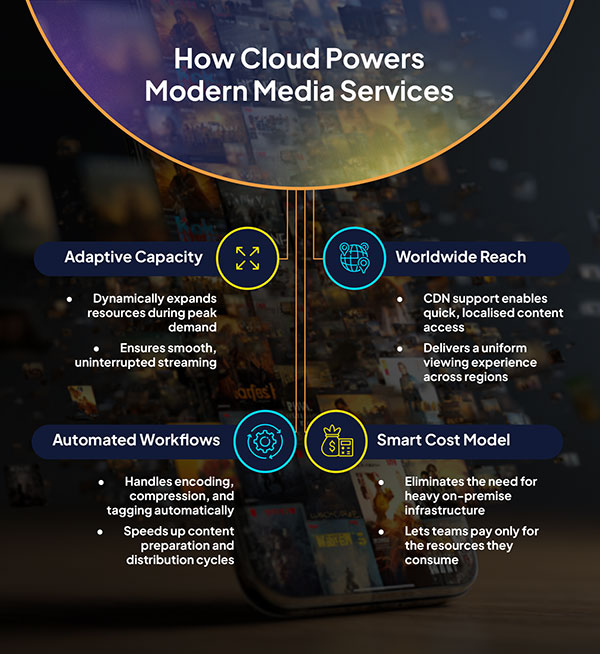
Cloud technology has become the driving force behind modern media ecosystems, enabling the scalability needed for unpredictable spikes - from live sports finals to viral content - while providing the intelligence, automation, and distributed architecture required to deliver content with minimal latency worldwide. By supporting cloud-based workflows that streamline production, accelerate post-production with AI-driven tools, and enable seamless global collaboration, the cloud has transformed how media operates. From OTT platforms modernising content delivery networks to studios adopting cloud-native editing and rendering, and enterprises building frictionless content libraries, cloud infrastructure integrates storage, compute, AI, and edge capabilities to help media companies innovate faster, adapt to shifting audience demands, and deliver richer, more immersive experiences.
Understanding Cloud Media Services
Cloud media services are platforms built on cloud infrastructure that enable organizations to store, manage, process, and deliver media content efficiently. They handle everything from large-scale storage and real-time encoding to seamless streaming, content collaboration, workflow automation, and metadata management. By consolidating these capabilities in the cloud, media companies can operate at scale, respond quickly to audience demand, and streamline production and distribution without the limitations of traditional on-premises systems.Growing With Audience Demand
One of the biggest challenges for media companies is handling fluctuating traffic.
Think of a popular show release or a live sports final — millions of users stream simultaneously. With traditional hardware servers, companies must buy and maintain expensive infrastructure for peak demand, even when it's not always used.
The cloud solves this through auto-scaling, which automatically expands or reduces resources based on traffic load.
Benefits:
• Handles sudden spikes in viewership
• Saves costs by paying only for resources used
• Delivers uninterrupted playback and higher user satisfactionGlobal Accessibility and Content Delivery
Audiences today are distributed across continents, expecting smooth, low-latency streaming regardless of location. Content Delivery Networks (CDNs), a key feature of cloud media services, cache and deliver content from servers positioned close to end users. This reduces latency, minimises buffering, and ensures a consistent viewing experience worldwide.Efficient Media Processing and Workflow Automation
Before content reaches viewers, it must be encoded, transcoded into multiple device-friendly formats, compressed for efficient delivery, and enriched with metadata for search and personalised recommendations. Cloud platforms automate these processes while enabling distributed collaboration among editors, producers, and designers. This accelerates production timelines and supports flexible, remote workflows essential for global media operations.
Cost Optimisation
Cloud media services eliminate the need for costly in-house data centers, ongoing hardware upgrades, and energy-intensive maintenance. By enabling pay-as-you-go resource models, media companies can align infrastructure costs with actual usage, turning capital-intensive operations into scalable, cost-efficient services.
The Future of Cloud Media Services
Looking ahead, cloud platforms will continue to redefine media operations. AI-driven personalisation, edge computing for localised delivery, 5G-powered high-quality mobile streaming, and immersive media experiences like AR and VR will become mainstream. The cloud is not just supporting the media industry — it is actively shaping its evolution, enabling companies to innovate, scale, and deliver richer experiences in ways that were previously impossible.
Sudarshan: Enabling Cloud-Native Media Operations
As cloud media services advance, the real challenge for media organisations is operationalising these capabilities without navigating fragmented tools, heavy engineering, or long deployment cycles. This is where Sudarshan OVP Service and Sudarshan Media Asset Management play an integral role. Both solutions translate the power of cloud infrastructure into ready-to-use platforms that streamline streaming, media processing, and asset management. Instead of building complex systems from scratch, media companies can adopt proven, cloud-native tools that accelerate go-live timelines, reduce operational overhead, and unlock the full value of their content.
Sudarshan OVP Service: Simplifying Streaming End-to-End
Building and running a streaming platform can be complex — from uploading and processing content to distributing it securely, managing subscriptions, and engaging viewers. Sudarshan OVP Service brings all of this together in one platform. It supports video and audio streaming, live broadcasts, and linear channels, while handling marketing, notifications, user support, and monetization in a single, integrated solution.
The platform also provides ready-to-use apps for websites, iOS and Android devices, and connected TVs such as Android TV and Amazon Fire TV. This eliminates the hassle of managing multiple vendors, saves time, and makes it much faster to go live. Its OpEx-based pricing means companies don’t have to invest heavily upfront and can choose custom features or integrations as needed. With regular updates, bug fixes, and security enhancements, Sudarshan OVP helps deliver a smooth and professional experience for every viewer.
Sudarshan Media Asset Management: Smarter Media Operations
Managing large volumes of media is about control, organisation, and making content work harder. Sudarshan Media Asset Management provides a single platform to handle their media efficiently. It comes with built-in tools for face and emotion recognition, object and scene detection, speech-to-text transcription, and even detecting objectionable content such as nudity, smoking, or alcohol.
The platform also includes generative AI features to recreate or repurpose videos from the library, adjusting formats and sizes as needed. Everything is integrated into the workflow, so teams don’t need to juggle multiple tools or complicated integrations. The result is faster production, better compliance, and more flexibility to deliver high-quality content.
Together, Sudarshan OVP and Media Asset Management help make media workflows more efficient, enabling faster operations and better content organisation. They offer a practical approach for teams managing increasing content volumes and shifting production requirements.